A mother crab watched her young crab moving across the sand. “Why do you always walk sideways?” she asked. “Perhaps you should learn to move straight ahead.”
The young crab answered respectfully, “I would be glad to learn. Please walk in front of me, and I will copy exactly what you do.”
PAGE 2
The mother crab stepped forward, but her legs naturally carried her sideways. She tried again and made the same kind of tracks as her child.
At last, she smiled. “Walking sideways is natural for both of us. I should understand my own actions before correcting yours.” Together, they happily crossed the beach.
Lesson: Advice is most meaningful when the person giving it can lead by example.
PAGE 3
The Traveller’s Great Jump
A traveller returned home with grand stories about distant places. One evening, he told his neighbours about a jumping contest.
“I leaped farther than every other contestant,” he boasted. “No one on the island had ever seen anything like it.” When someone asked for proof, he said they would have to travel all the way to the island.
PAGE 4
A wise elder smiled. “There is no need to travel so far. Let this patch of grass be the contest ground, and let us be the judges. Show us your jump now.”
The traveller realized that his story had grown larger each time he told it. He admitted the truth and gave an ordinary—but honest—jump.
Lesson: Real ability is shown through action, not impressive claims.
PAGE 5
The Thirsty Goat’s Mistake
A fox slipped into an old well and could not climb the smooth walls. Soon, a thirsty goat looked over the edge.
“The water is cool,” called the fox, hoping the goat would jump in and help him escape. The goat nearly leaped before pausing. “How would we get out afterward?” he asked. The fox had no safe answer.
PAGE 6
The goat called to nearby villagers instead. They lowered a sturdy ladder and helped both animals climb out safely.
The fox apologized for inviting the goat into trouble without thinking about his safety. The goat was glad he had considered the way out before jumping.
Lesson: Before entering an uncertain situation, think about the consequences and make a safe exit plan.
PAGE 7
The Fisherman and the Little Catch
A fisherman spent many hours gently lowering a net into the sea, hoping to observe the day’s catch. Near sunset, he found one tiny silver fish.
The little fish seemed modest beside the large catch he had imagined. Still, the fisherman looked closely at its shining scales and made a careful sketch while it rested in a tub of seawater.
PAGE 8
“One real discovery is better than pretending I found a hundred,” he said. He thanked the little fish and released it back into the waves.
His basket remained empty, but his page held an honest record of the day. He went home pleased with the small progress he had truly made.
Lesson: A modest result that is real can be more valuable than a grand reward that exists only in our hopes.
PAGE 9
The Shepherd Who Lost Everyone’s Trust
A young shepherd watched sheep near his village. Feeling bored, he twice rang the warning bell and called, “Wolf!” Villagers hurried to help, only to discover that he was joking.
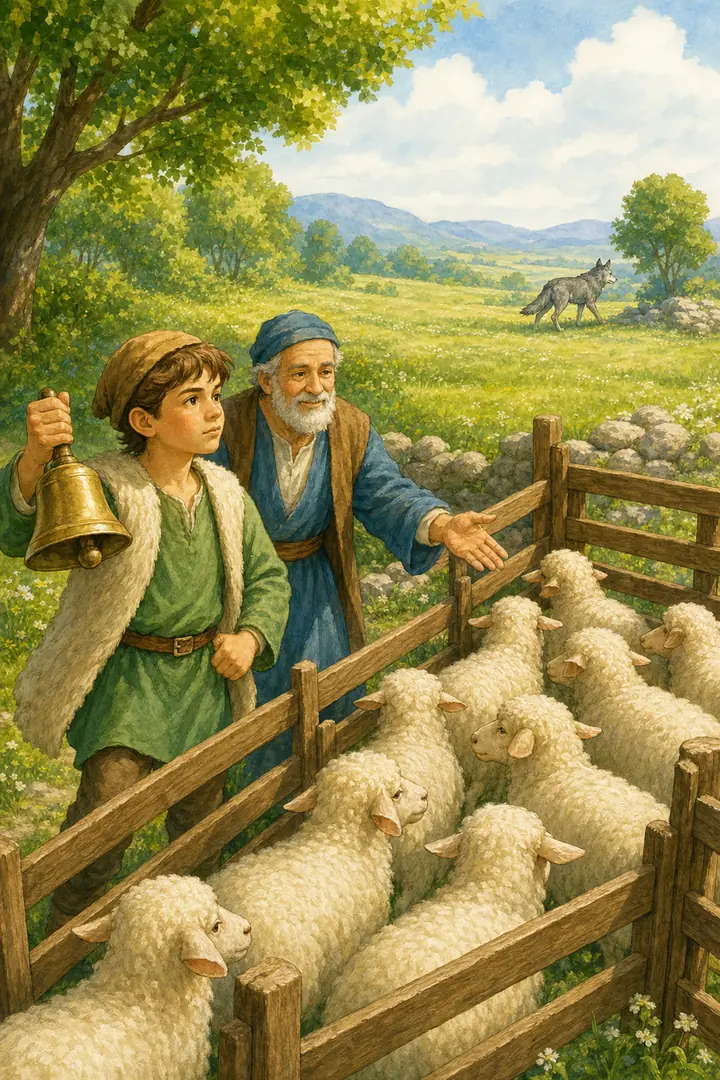
A few days later, the shepherd saw a real wolf far across the meadow. He rang the bell again, but most villagers assumed it was another trick.
PAGE 10
A wise elder came to check and helped guide every sheep into a secure pen. The distant wolf turned away.
The shepherd apologized to the village. For many weeks, he used the bell only for real warnings and kept careful watch. Slowly, his dependable actions earned back their trust.
Lesson: Repeated lies weaken trust, and rebuilding it requires honest actions over time.